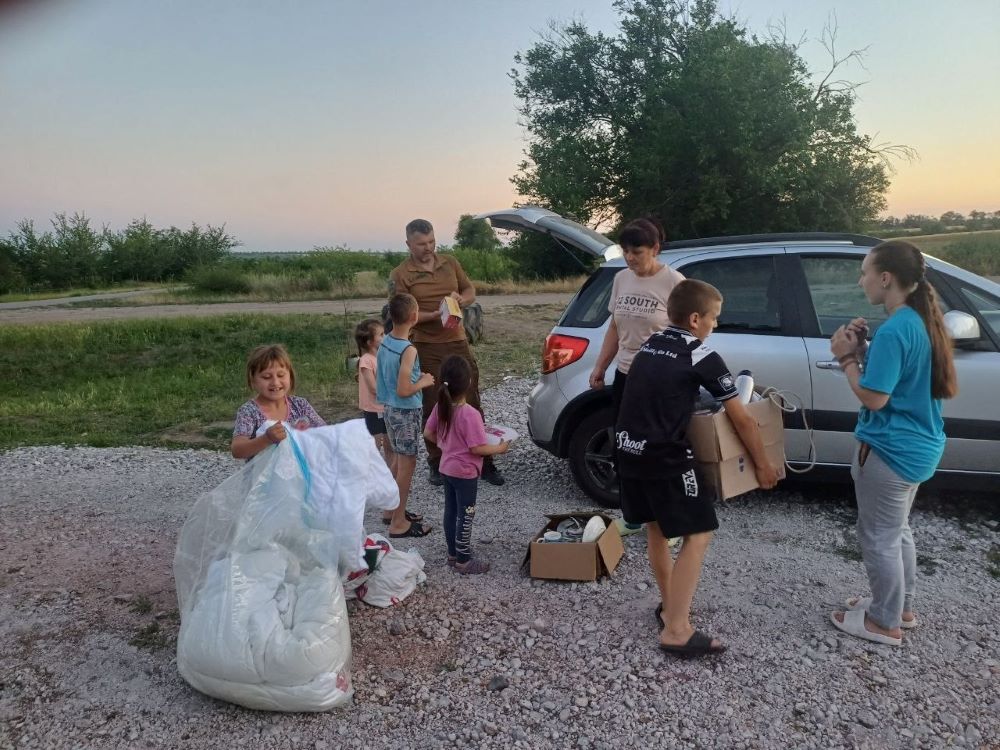
Helping war-affected families rebuild the essentials of home — one household, one need, one act of care at a time.
Project by the International Charitable Foundation “Step with Hope” (“Krok z Nadiieiu”).
When war forces a family to leave home, the loss is measured in more than walls and rooms. It is the bed left behind, the kettle used every morning, a child’s winter coat, the washing machine that made daily life manageable — and the familiar objects that once made a place feel safe.
Emergency aid can provide food or financial support. Yet thousands of displaced families continue for months, sometimes years, without the basic household items they need to live with dignity. “Care Has an Address” exists to close that gap.
We do not deliver standard boxes to anonymous recipients. We listen to each family, understand what is missing, and build practical support around real lives.
When Starting Again Means Starting From Almost Nothing
More than 4.6 million people in Ukraine are registered as internally displaced. In Dnipropetrovsk, Kharkiv, and Donetsk oblasts alone, more than 500,000 displaced households are living away from home, and over 300,000 families need basic help to equip their accommodation.
Many have been displaced for more than two years. Savings are exhausted. Replacing furniture, appliances, bedding, clothing, and other essentials is simply beyond reach. A family may have a roof, but still lack the everyday conditions that turn shelter into a home.

A Different Kind of Humanitarian Aid
“Care Has an Address” is a personalised humanitarian support system. Each household receives an individual package based on an assessment of its actual needs. Depending on the family, support may include:
- furniture and beds;
- refrigerators, washing machines, kettles, and other household appliances;
- clothing and footwear;
- bedding and household textiles;
- kitchenware and practical household items;
- other essentials needed to restore safe, dignified daily life.
This approach makes donor resources more effective. Useful items go where they are genuinely needed, duplication is reduced, and every delivery can create a visible improvement in a family’s quality of life.
They Remembered What Varvara Loved
“When we filled in the form, the coordinator asked what my granddaughter liked to do,” Anna Herasymivna said through tears. “I told her Varvara loved drawing, although it hardly seemed important then. But they remembered. They heard us.”
June 2026 was exceptionally hot, but inside a small displacement centre in Nikopol, the day had its own momentum. Volunteers from Step with Hope checked names against lists. A delivery of personalised assistance had arrived for families evacuated from the shelled village of Bilenke in the Marhanets community.
One box was for the Kucherenko family: Anna Herasymivna and her seven-year-old granddaughter, Varvara. They had left in a hurry, to the sound of explosions, carrying only their documents and their cat, Persyk.
Volunteer Yuliia brought the heavy box to their room. Inside were the practical things the family needed: bedding, household essentials, and a large kettle. On top was a smaller surprise — a thick drawing pad, a large set of coloured pencils, and a soft teddy bear that looked remarkably like the one Varvara had left at home.
Varvara sat down on the floor and began to draw. Her first picture was a bright sunflower beneath a peaceful blue sky.
Personalised aid is attention made tangible. Sometimes it is a washing machine or a bed. Sometimes it is a box of pencils that tells a child: your interests still matter; your childhood still matters; you were heard.
How the Project Works
- Families are identified. Volunteers work with social services and community partners to find households facing the greatest need.
- Needs are assessed. Each household completes an individual assessment so the team understands what will make the most practical difference.
- The right items are collected. Partners and volunteers in Ukraine and Germany source the requested furniture, appliances, clothing, and household goods.
- Aid is prepared and transported. Items are checked, sorted, packed, and delivered to the central humanitarian warehouse in Dnipro.
- Support reaches the family. Mobile volunteer teams deliver directly to households or organise distribution through trusted humanitarian centres.
- Every delivery is documented. Handover records, appropriate photo documentation, and outcome monitoring provide transparency and accountability to partners.
Built on Experience, Ready to Scale
The project grew from Share the Warmth, a volunteer initiative launched in Dnipro in 2017. After the full-scale invasion, the work expanded significantly. Today, more than 60 volunteers in Ukraine and Germany contribute to an established system for international transport, warehouse handling, record-keeping, reporting, and personalised distribution.
The project currently serves communities in Dnipropetrovsk, Kharkiv, and Donetsk oblasts. Its resource network also extends to Germany, where volunteer collection points and international partners help gather humanitarian goods.
This experience shows that a volunteer-led model can be practical, transparent, and scalable — without losing the personal attention that makes the support meaningful.
What Eight Months of Support Can Achieve
With full funding and the infrastructure already in place, the project plans to:
- support more than 4,000 families;
- reach over 10,000 people;
- recruit more than 50 new volunteers;
- complete over 80 mobile humanitarian missions;
- organise at least 8 international humanitarian deliveries.
These targets are based on the team’s existing logistics network, volunteer capacity, and operational experience.
More Than Things
A bed means rest. A refrigerator means food can be stored safely. A washing machine gives time and energy back to a caregiver. Warm clothing means a child can go outside. A table can become the place where a family eats together again.
The project helps displaced families adapt more quickly, reduces social vulnerability, supports integration into new communities, and strengthens a culture of solidarity between communities in Ukraine and across Europe.
Most importantly, it helps restore something war tries to take away: the feeling that life can become normal again.
Why Partners Choose This Project
Personalised. Each family receives what it actually needs.
Efficient. A volunteer-led model directs a greater share of resources towards practical help.
Transparent. Deliveries are documented, appropriately photographed, monitored, and reported to partners.
Scalable. The existing system can expand to new communities and regions without sacrificing quality.
The Funding Need
The project requires €73,000 to operate at full capacity for eight months. Funding supports:
- the coordination team;
- the humanitarian warehouse;
- international and domestic logistics;
- mobile missions to affected communities;
- sorting, packing, and last-mile delivery;
- monitoring, documentation, and partner reporting.
Because much of the work is carried out by volunteers, the project can use funding efficiently and direct more resources towards the families themselves.
Partner With Us
“Step with Hope” invites international foundations, charitable organisations, companies, community groups, and individual donors to help displaced families rebuild the essentials of everyday life.
Partnership can take the form of grant funding, sponsorship of a delivery or household, in-kind donations of suitable furniture and appliances, logistics support, professional services, or long-term cooperation through collection points in Ukraine and Germany.
When you support “Care Has an Address”, you do more than provide things. You help a family sleep safely, prepare a meal, care for a child, and begin to feel at home again.
Care should never be anonymous. Together, we can make sure it reaches the right door.